Recovered archive. Dates, ages, roles and announcements reflect the original publication; they are not current updates.
Ali Naser describes the multiple punishments people in countries such as Syria and Yemen endure during this pandemic: further restrictions on civil liberties, health authorities’ lack of transparency, the struggle for food and a basic income, and unending war with its rules and surprises. It is another perspective on the coronavirus crisis, one absent from our Western viewpoint.
Despite speculation about what coronavirus is and whether it was manufactured or produced by nature, the only established fact so far is that it emerged and grew in the Chinese city of Wuhan. From there it travelled, or was exported, around the world. Nobody knows except the Chinese themselves, who remain on the defensive against American accusations and provocations that in turn lack conclusive evidence implicating China in this pandemic. It has swept across the world and exposed the weakness of the strongest countries’ health systems in responding to it.
Researchers and analysts have said that disaster scientists failed to predict the unpredictable, and that is not far from the truth.
Yet in recent decades American and world cinema have repeatedly produced films about a virus or biological war striking the planet. On the big screen we have watched confusion, governments collapsing, chaos prevailing and events spiralling out of control. Many scientists and prominent figures also warned that the next war would not be conventional but biological, fought through viruses. This pandemic has not unfolded exactly as those films depicted. Despite the world’s weak response, however, it was not beyond expectation; rather, scientists and those concerned misjudged how far away those scenarios were.
Although countries have responded with varying degrees of effectiveness, poor and conflict-affected countries remain the weakest link, especially those ruled by dictatorships and repressive regimes. Public safety is not their priority; most spending goes towards their security apparatus and governing system.
In Iran, despite extensive spread in its cities, preventive measures were withheld until the parliamentary elections ended, contributing significantly to the rise in cases. Infection and death figures are also inaccurate because of the tight security grip preventing accurate reporting.
In Communist Party-ruled China, those speaking about the virus and case numbers outside official channels were arrested and disappeared. Despite their weaknesses and confusion, Western countries remain more transparent in handling this disaster. The world has seen harsh images of the virus’s consequences, moving words from many leaders and the Italian prime minister crying during his speech. Meanwhile, Syrian President Bashar al-Assad celebrates his wife’s birthday with a painting bought for thirty million US dollars, while Syrians starve in towns, villages and camps and suffer terribly under a war that spares nothing.
While many countries closed borders and land and air entry points as precautions, the Syrian government has not even closed its already wide-open borders.
Social distancing and solidarity campaigns have been remarkably successful in slowing the virus in Europe and developed countries, but have failed disastrously in poor countries. People in developed countries can stay home for weeks because they can afford the available supplies. People in poor and war-torn countries cannot even secure their daily food.
Dictatorships therefore turn to states of emergency, the close companions of repressive regimes, enforcing restrictions on destitute citizens with excessive brutality. Regimes governing countries threatened with revolt against their rulers and worsening living conditions may find a golden opportunity to impose emergency rule. It prevents revolutions, strikes and civil disobedience, giving the ruler a warrior’s respite to regroup and devise further ways to remain on an eternal throne inherited by his children.
People in poor countries generally, and war-torn Syria, Yemen and Libya especially, therefore attach little weight to the pandemic’s scale. They have experienced deadlier, fiercer and crueller ways of dying, so death by the virus can seem a form of merciful death. They struggle to stay alive and escape a war that most countries have either watched or participated in through their political and ideological alignments. People live without the basics: no electricity, no food, even scarce water, alongside widespread ignorance, closed schools, attacks on hospitals and health facilities, and no virus-testing equipment.
Health and education have become forgotten matters. Hungry people think only of their daily food and survival.
Finally, we hear much about a new world order, a world after coronavirus different from the one before it: America’s light fading, signs of the EU’s collapse, a powerful Chinese giant coming to take its place as a principal actor, and new powers emerging. Speculation abounds, yet we remain in the eye of the storm with no change so far. A simple look at the overall reality, rather than isolated parts, suggests that while America attacks China and China remains defensive, the world order has not changed and will persist for the foreseeable future. There is just one change: more hungry people around the world.
Ali Naser
29 May 2020
Discover Ali’s biography here.
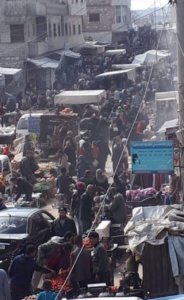
(Photograph of al-Dana, Idlib, by Ali Naser.)