Recovered archive. Dates, ages, roles and announcements reflect the original publication; they are not current updates.
In this contribution, Ibrahim Heggi offers Arab readers a review of the latest political developments in Italy: divisions within the governing coalition, tensions with Europe over public spending, recent controversial migration measures, and the social debate challenging unsustainable development policies. Maydan publishes it as part of preparations for an Arabic edition of its website.
The new Italian government was sworn in before President Mattarella on 1 June. It consists of an alliance between the populist Five Star Movement, which won the largest share of votes in the March parliamentary election under Di Maio’s leadership, and Salvini’s Northern League. The latter set aside its alliance with the right — Berlusconi’s party and Meloni’s party — until it should need it again.
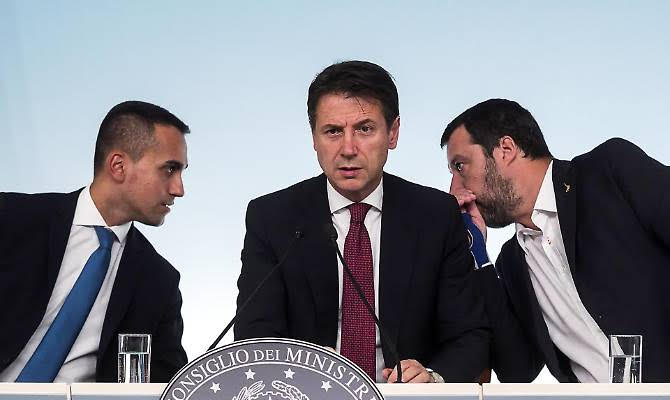
The two governing partners agreed a contract intended to deliver their main election promises. They chose Giuseppe Conte to head the government, with Salvini as first deputy and interior minister, and Luigi Di Maio as second deputy and labour minister.
Since taking office, Salvini has used his Facebook page to continue his election campaign, make media statements and comment on current events. His primarily populist rhetoric has outstripped even that of the Five Star Movement itself. He courts followers with a weekly live broadcast from his office explaining his plans and foreign visits, and searches crime reports for anything involving foreigners and migrants to share with them. This unprecedented hate speech has influenced the legislation he submitted to both parliamentary chambers, called the “Security Law”. Most of its provisions were directed against migrants, with just one concerning the mafia and another the police and firefighters. In other words, it tied security to migrants.
The Five Star Movement initially searched for funding for its leading election pledges: pension legislation and a generous unemployment allowance. At the time of writing it had not secured the money and had to postpone implementation until the following year, despite repeatedly announcing that funding was available. Over time it suffered from Salvini’s dominance of the media’s political scene and the Northern League’s resulting pull on other right-wing parties and groups. In the latest December poll, the League reached 34.7%, compared with 17.4% in March, while Five Star fell to 24.9% from its March vote of 32.7%. Some saw this as Salvini’s undeclared goal in maintaining a permanent campaign: winning new votes. This is indeed happening, making him Italy’s strongest political figure.
The new government faces major challenges, particularly after its dispute with the European Union over the proposed budget’s rejection. European shares fell, affecting the value of the single currency. The government’s attempts to fulfil election promises that the European Commission describes as ill-considered would increase the budget deficit beyond the limit permitted by the European Central Bank.
In foreign affairs, the government’s policy towards Libya has become clearer. It leans towards the Islamist camp, or the Presidential Council in Tripoli, contrary to Five Star’s election programme, which said Libyans would be left to decide their own fate. This was the interpretation of Salvini’s statements after recent visits to Tunisia and Qatar, and of Italy’s efforts to convene the Palermo conference on Libya. France would of course try every means to undermine it, just as Italy did to the Paris conference, with Russian backing. Italy is now clearly alongside Qatar and Turkey in supporting the Presidential Council, while France, the UAE and Egypt support Haftar, with Algeria moving between the camps. It is worth noting that gas pipelines from Libya to Italy did not stop operating even during the armed conflict following Libya’s 2011 revolution. But Salvini seems to be seeking Qatari money alongside Libyan gas.
On gas and energy, the disagreement between Italy’s two governing partners was clear. Five Star opposed the TAP pipeline bringing gas from Azerbaijan through Turkey and Albania, seeking to preserve relations with Russia, which supplies 38% of Italy’s gas needs. Salvini, however, saw no problem with TAP and said so in response to demonstrations in southern Italy opposing the Azerbaijani pipeline because of its harmful effects on the local environment and communities. Internationally, Europe’s rising right-wing populist movements also favour Salvini over Five Star, and are coordinating an alliance for the May 2019 European Parliament elections.
The partners also differ over the project known in the media as TAV: a high-speed freight railway and tunnel linking Italy’s Turin with France’s Lyon. Five Star opposes the project, building on the political work and campaigning of the strong NO-TAV social movement; Salvini supports it.
As for the opposition, the Democratic Party — the party of former prime ministers Gentiloni and Renzi — appears to be undergoing radical reorganisation through an internal election for a new leader. This has left virtually no opposition since the government took office in June. Italy’s only opposition today therefore remains its public debt, “SPREAD”, estimated at a quarter of the eurozone’s debt.
Ibrahim Heggi