Recovered archive. Dates, ages, roles and announcements reflect the original publication; they are not current updates.
This article recounts Iraq’s more recent suffering, highlighting the even greater importance of Pope Francis’s universal message against war during his recent visit. At the same time, Jabbar explains that the country’s troubles are rooted in unequal rights and opportunities among Iraqis, and that any geopolitical solution based on sharing power along sectarian and ethnic lines is destined to keep producing disasters. The popular protest movements against the status quo that have spread, especially since 2019, are the country’s true hope.
Adel Jabbar is a sociologist and essayist working on intercultural studies and migration. A close observer of the Middle East’s historical and geopolitical dynamics, he has promoted numerous cultural projects and literary, artistic and film programmes. Originally from Iraq, he has lived and worked in Italy for many years.
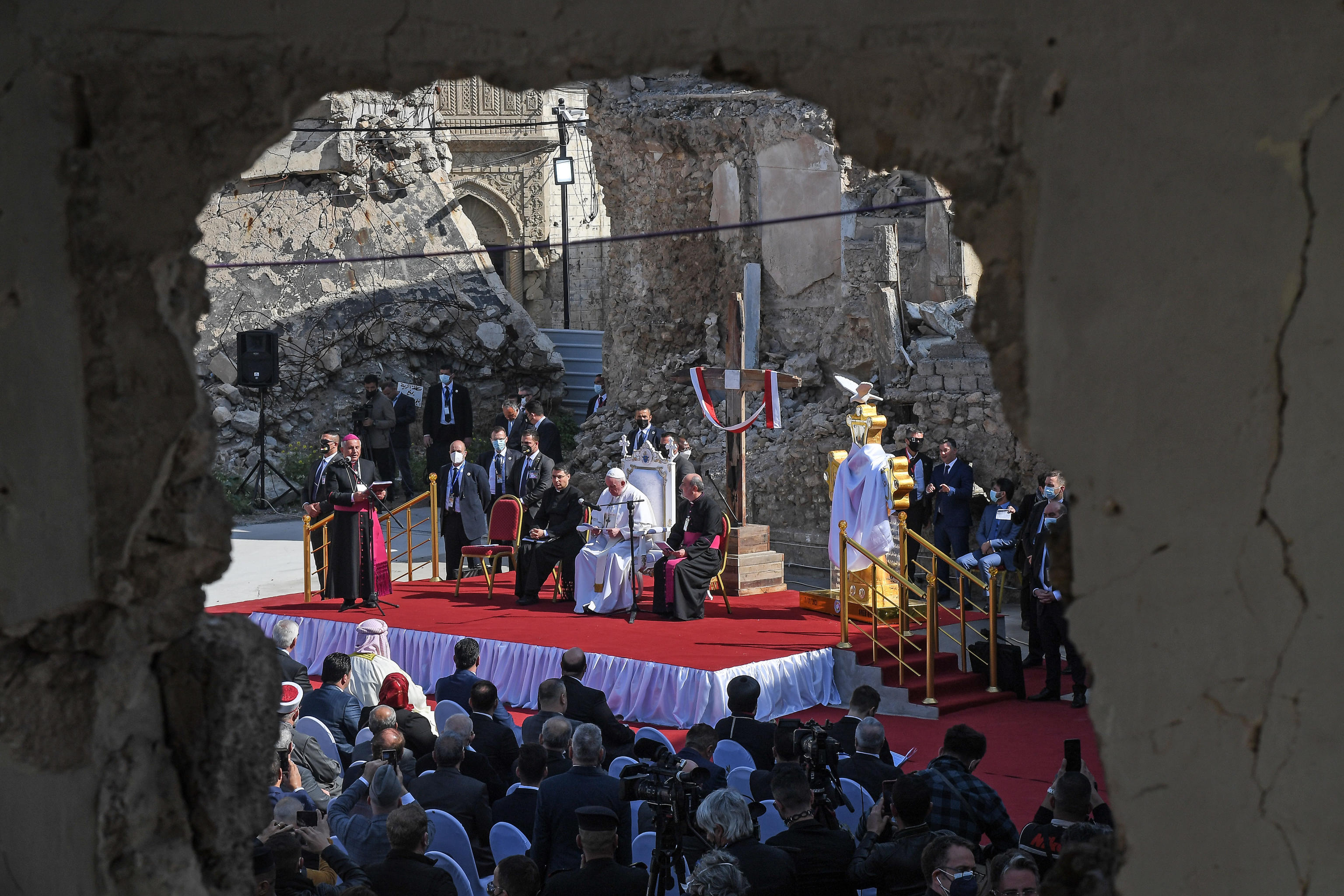
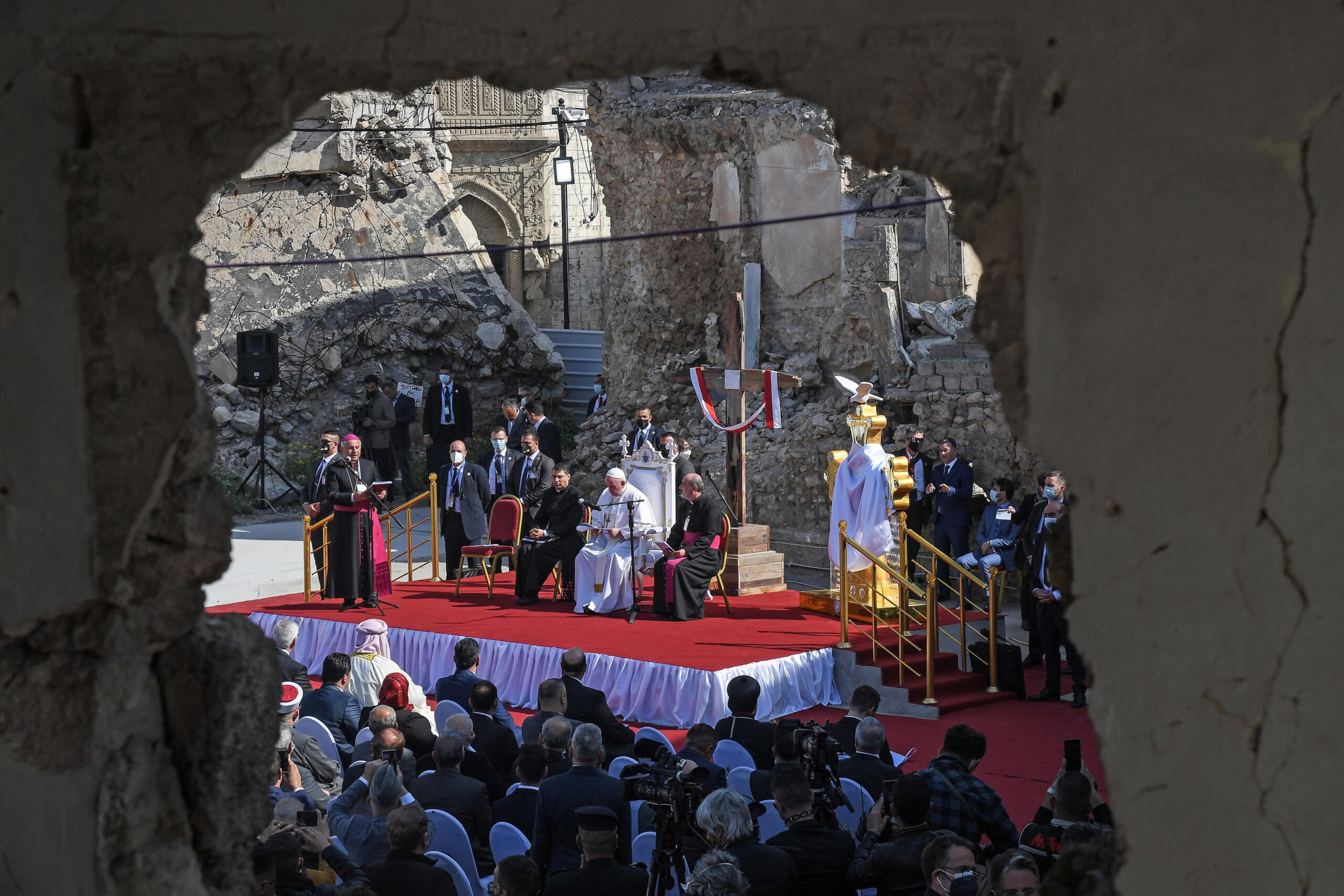
Pope Francis’s decision to visit Mesopotamia requires careful analysis in light of the complex geopolitical dynamics of the Near and Middle East.
The pontiff travelled to an area still marked by geopolitical confrontation: foreign armies unwelcome to local populations are present, transnational terrorism operates daily, and bitter conflicts between factions are often supported by international actors of every size. Despite all this, the head of the Vatican state wanted to complete an important visit.
After the media euphoria and the many statements and comments about the pontiff’s journey, I would like to draw attention to one aspect of his remarks at its various stages.
It is political in nature and concerns his criticism of warfare as a principal cause of the severe conditions in which many of the world’s peoples live. The Pope repeatedly stressed that war is an act of domination. Iraq offers a stark and tragic demonstration: a strategically important country rich not only in raw materials, but in human resources and an immense historical and cultural heritage, subjected to two wars launched on the basis of blatant, disgraceful lies. One was the story of Iraqi soldiers throwing babies from incubators onto the floor in Kuwait in 1991. It was told before the US Congress by a supposed nurse, later revealed to be the fifteen-year-old daughter of Kuwait’s ambassador to the United States, coached by an American public relations agency. A lie was again used for the 2003 war: the story of weapons of mass destruction, complete with a vial held up by then Secretary of State Colin Powell. These truly could be called the mother of today’s fake news! As the second episode of the four-part documentary series “Iraq: The Destruction of a Nation”, broadcast on Rai Storia on 3 March 2021, shows, these lies are now recognised as such even by several UN figures involved at the time, including UN humanitarian aid coordinator Denis Halliday and Hans von Sponeck, coordinator of the UN health programme in Iraq. The misinformation won support for military intervention among sections of world opinion while leaving Iraq’s population terrorised and brutally devastated. Those responsible for these war crimes remain unpunished to this day; they continue spreading lies, and their successors perpetuate the same destructive actions elsewhere.
The Pope’s statements in Iraq call to account those who manufacture and sell arms and devise war plans, confronting them with the fatal consequences of their actions: death, rubble, refugees, resentment, despair, social fragmentation and political instability.
Since 2003, when the Anglo-American alliance invaded Iraq, the country has suffered numerous fractures and divisions. General disorder now prevails, corruption is systematic, and militias under different names hold sway across its territory. These are only some of the invasion’s tragic consequences for this ancient land, already damaged by years of despotic rule under Saddam Hussein’s clan, the war with Iran (1980–1988), the first Gulf War following the Iraqi army’s occupation of Kuwait (1991), and years of US embargo (1990–2003). That embargo cost more than a million Iraqis their lives, including 500,000 children. Finally came the occupation from 2003 and the establishment of a deliberately unstable political arrangement.
From 2011, large sections of this exhausted, tormented and exasperated population finally decided to reclaim an active role in public space. They created important protest movements against the status quo, demanding fundamental rights long denied by clan, family and sectarian power holders.
Since October 2019, these courageous peaceful protests have intensified further, despite savage repression by the “security” apparatus and militias. They continue tirelessly to denounce corruption and the absence of a state guaranteeing public order and its citizens’ fundamental rights. The young demonstrators, mostly drawn from the Shia population, fiercely criticise those managing public affairs, who themselves are also predominantly Shia. This refutes a culturalist interpretation claiming that the region’s sociopolitical dynamics arise exclusively from religious and sectarian affiliations. Iraq’s youth movements have exposed the original structural flaw in the political order born of the US occupation, based on a sectarian and ethnic vision in which local satraps and family dynasties exercise power disguised in clerical robes, “religious turbans” and “tribal turbans”.
Power is effectively managed by cliques that have divided up the country and its wealth, creating personal fiefdoms. Many analysts and observers of the region identify the 2005 “Constitution” itself, with its logic of sharing power along sectarian and ethnic lines, as the principal factor responsible for this disaster.
This situation is no longer tolerable or sustainable. Political practice therefore needs radical revision to change the institutional order, recognising the importance of participation by all social and political forces that have long demanded institutional reform. They call for a new constitution centred on citizenship rights and equal opportunities for all Iraqis, women and men, without distinction.
To understand the effects of Pope Francis’s visit on the tangled and thorny situation in the “land of the two rivers”, we must therefore continue observing political developments and the next moves of its many internal and external actors.
18 March 2021.