Recovered archive. Dates, ages, roles and announcements reflect the original publication; they are not current updates.
Giusy Rossi, who recently joined Maydan, lives and works in Florence in youth policy. An expert in European project development, she advises the European Commission and Italian National Agencies on project evaluation. A human rights activist, she graduated in Sociology and Social Research in 2019 with a dissertation on Albert Camus and the relevance of his thought to European policies on refugees and asylum seekers. This contribution honours Algerian culture at a difficult moment of questioning the political regime and invites us to rethink the concept of the “foreigner” through Algerian literature.
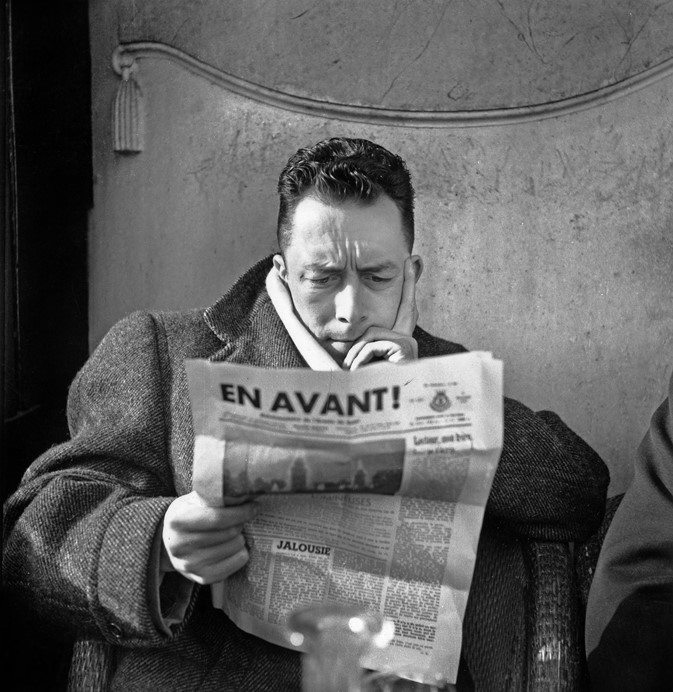
Albert Camus remains an emblem of the engaged intellectual, a reference point for his attentive, lucid and incisive gaze on the misery of the human condition during Europe’s tragic years of twentieth-century totalitarianism. A writer, journalist, playwright and philosopher, Camus belonged to a generation that grew up in poverty, around the Second World War, the Spanish Civil War and the Franco-Algerian conflict, when thousands risked their lives every day.
We might easily be tempted to divide that world into victims and executioners. Yet, faced with these great historical events, his critical approach asks us to interpret reality’s complexity beyond established categories. Camus rejected the veil of ideology without losing hope and faith in humankind. His vision is not exhausted by the nihilism characterising some existentialist thinkers of his time; it still offers a perspective that can inspire us. In his masterpiece The Stranger (1942), Camus opens us to the Other within ourselves, bringing us face to face with the darkness of our deepest intimacy and the absurdity of human destiny: a man killed because of a blinding glare, and another subjected to a ridiculous trial that ends in a death sentence.
His approach recognises an inseparable bond between human solitude — the absurd — and the possibility, despite it and indeed beginning from it, of building collective solidarity. This is captured in his famous phrase “I rebel, therefore we are”, echoing Descartes’ “cogito ergo sum”. It affirms that people can move beyond themselves and their solitude by committing to an ideal of equality and shared justice. His thought can therefore help us interpret the contemporary crisis. An economic approach alone cannot explain our times: we also need a philosophical gaze allowing us to probe the most controversial aspects of human consciousness.
Consider for a moment the ethical challenges closest to us as European citizens: inequality, forced migration, deaths in the Mediterranean. In an increasingly multiethnic society where we must live alongside difference, how can we build an open society capable of welcoming the Other’s perspective? When does the Other become a stranger, and the stranger an enemy? How can our communities, institutions and laws include concerns arising from other cultures?
Great literature comes to our aid. It is worth remembering that the novel’s protagonist, Meursault, blinded by sunlight, kills an Arab on a beach in Algiers. The victim remains a nameless Arab until the book’s end and leaves the scene immediately, like a minor actor, making room for the murderer’s realisation of humanity’s absurd condition.
Here, on the ground of literary imagination, fiction connects with today’s reality. The door left open by Camus’s great novel admits a new interpretation: that of the so-called Arab Springs, the democratic awakening of Algerian civil society. The victim’s silent cry finds a listener in a new counter-investigation by Algerian journalist Kamel Daoud. Seventy years later, he rewrites the novel from the opposite viewpoint to discover who the nameless victim really was (The Meursault Investigation, 2014). Through his narrative, this symbolic act of rebellion on behalf of countless forgotten victims of violence also becomes a form of popular reclamation and reworking of memory.
The two authors’ invitation to “decolonise” our gaze suggests we can seek new, plural meanings in words. Who is the Other? Who is the stranger today? Psychologically, the Other is our mirror, always present and reflecting our own identity, which develops through dialogue with those different from ourselves.
The stranger’s presence confronts us with a basic ambivalence: both gift and threat, it places us before the unknown and the ambiguous. It attracts us but also frightens us, destabilising our balance and forcing us towards a new synthesis. In our globalised cities, today’s stranger is undoubtedly the migrant: an uncomfortable presence seemingly calling our certainties and identity into question.
Another key concept comes from Algerian sociologist Abdelmalek Sayad, who describes immigration as a total social fact, involving every cultural, political and economic sphere. Any proposed action should therefore consider all these aspects. Finally, there is the most intimate dimension of the migrant’s condition: “double absence”. This is a suspended state in which people leave their country of origin behind, lose their role and venture into an unknown that, especially in forced migration, may hold potential but is wholly undefined and often extremely treacherous, even life-threatening.
Reading The Stranger alongside Kamel Daoud’s counter-investigation reveals further compelling themes. Daoud has spoken out, given a face to the nameless Arab and transformed the story into an epic. In light of recent events in Algeria, he seems to embody a new narrative for his people. Through rewriting, he declares his wish to restore the dignity of a name and a personal history to characters left in the shadows of The Stranger. Daoud is a journalist, one of the principal reporters of the Arab Springs, and also a controversial figure because he refuses to remain hostage to colonial history. In this book, he addresses compatriots who, he says, seem asleep. It is important to stress that this is not a mirror-novel: it does not reproduce the original plot step by step but reinterprets it, rather as jazz improvisation reinterprets a familiar melody.
He invites us to move beyond the role of victim and recover independent thought and an active civic role. Ultimately, there is no opposition between the two books’ characters: the new novel’s protagonist turns out to be very similar to Meursault, sharing the same uprootedness in life and society. Both novels leave us with open endings, holding us in suspense and inviting us to find our own meaning for the story’s conclusion.
The authors help us reflect on their characters’ uprooted, alienated condition. They do not understand life and are themselves misunderstood by those around them. In a sense they experience an excess of uprootedness closely resembling migrants’ double absence today. Both authors turn to literature, convinced of the saving power of words rather than taking up arms; they share an absolute rejection of violence. They invite us less to seek comfort in memory than to use it as an impetus to interpret and question the present.
We need to rediscover the local community as a place to regenerate social ties and enable active participation by all its members, including foreign residents. Institutions — schools, museums, hospitals and prisons alike — should open themselves more fully to their surroundings, working towards dialogue and social coexistence. The language of art, like literature, can therefore be valuable in community work, giving voice to diversity and different perspectives.
Giusy Rossi
Bibliographical references
Albert Camus, Lo straniero (1942), Edizioni Bompiani, 2015.
Kamel Daoud, Meursault, contre-enquête, Actes Sud, 2014.
Abdelmalek Sayad, La double absence. Des illusions de l’émigré aux souffrances de l’immigré, Seuil, 1999.