Recovered archive. Dates, ages, roles and announcements reflect the original publication; they are not current updates.
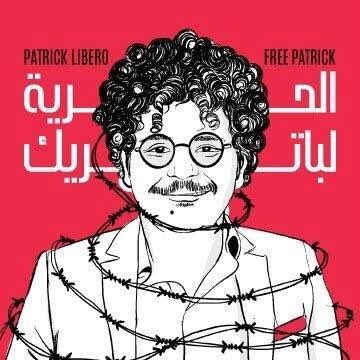
In this article, originally published in La Voce delle Lotte, Maydan co-founder Ibrahim Heggi and journalist Mattia Farouq describe the fate of Egyptian student Patrick Zaky, who was arrested and tortured after arriving in Egypt from Italy, where he studies. “Patrick, like others, is simply the latest victim of a sick regime that, unable to solve the country’s chronic problems, tortures, imprisons and kills in the name of regional stability, with the tacit approval of Italy and the European Union,” they write.
Patrick George Zaki is a 27-year-old Egyptian activist studying Women’s and Gender Studies at the University of Bologna. According to his lawyer, Egyptian security forces arrested him at Cairo airport at four in the morning on Friday 7 February. The charges include spreading false news, threatening national stability, inciting unauthorised demonstrations, attempting to overthrow the regime, “misusing” social media to damage its image, propagandising for terrorist groups and using violence. In Egypt, such charges can carry life imprisonment.
He had been planning a holiday in his home country, where his parents live in Mansoura. Patrick was untraceable for 24 hours and ordered into custody for 15 days in a rapid decision. His parents told Repubblica that he underwent 30 hours of interrogation, blindfolded and handcuffed, repeatedly beaten and given electric shocks. His captors wanted to know “his connections to Italy and Giulio Regeni’s family. But he knows nothing about any of this”. Hoda Nasrallah, a member of his legal team, also confirmed that “he was subjected to electric shocks and beaten, but in ways that left no visible marks on his body”. A similar procedure was inflicted on Zaki’s friend Amr, a 29-year-old Egyptian who has long lived in Berlin. Amr told ANSA that Egyptian security forces abducted him, interrogated him for 35 hours, blindfolded and tied him up, beat him and deprived him of sleep.
Since Saturday 8 February, Patrick has been held in a detention room at Mansoura-2 police station in his home city, 120 kilometres north of Cairo. An international solidarity campaign for his release and against the Egyptian state’s human rights violations began immediately. In Bologna, a vigil took place in Piazza Nettuno for four consecutive days. Initiatives are also continuing in Granada, headquarters of the European GEMMA master’s programme in which he is enrolled.
A regime in difficulty behind a repressive façade
The methods and accusations are the same. It is no coincidence that, particularly since the protests of 20 September 2019, the Egyptian regime has tightened its grip on activists and social networks. Videos released by self-exiled Egyptian businessman and actor Mohamed Ali, denouncing corruption and wrongdoing by the ruling military bourgeoisie over contracts and funding, prompted the regime to monitor activist networks even more closely. Amid the political and social ferment in the Middle East, illustrated by street protests in Lebanon, Sudan, Iraq, Algeria and, in part, Libya, Egypt’s regime maintains a façade of domestic stability that serves the expansion of Western capital’s business in the country.
In one of his latest interviews with the DIRE news agency, Patrick Zaki said Egypt was anything but stable: “Egypt is not a stable country at all, whether socioeconomically or in terms of fundamental freedoms. People cannot find work, the cost of living keeps rising, and the government does everything it can to restrict the space for dissent.”
Despite the regime’s apparent strength in guaranteeing “order and security”, its ruthless suppression of dissent demonstrates the political weakness of al-Sisi’s security system. As last September’s protests showed, the country’s much-trumpeted economic growth again rests on the shoulders of workers, the Egyptian working class. Austerity policies, despite small concessions over subsidies, and IMF dictates have reduced around 40% of Egyptians to hunger. Against this background, the coup-born al-Sisi regime represses people undisturbed, with the “blessing” of the European Union and Italy. According to the figures, Italy’s trade with the regime in arms, gas and tourism reached 4.5 billion in 2019, with oil and gas exports increasing by 31% and 200% respectively. Arms exports rose from 7 million in 2018 to 69 million in 2019, while tourism increased by around 40% over the preceding year. This is a boon for Italian capitalism, ENI foremost, which makes lucrative deals with its “indispensable partner” while legitimising it domestically and internationally.
The Italian institutions’ timid reaction to the student’s arrest is therefore unsurprising, as they once again profess confidence that al-Sisi’s regime acts with full respect for the individual. The idea of monitoring his trial through European observers is, in effect, another helping hand to the dictatorship. Here, the Egyptian regime’s strength lies in operating within the country’s laws. Everything appears normal and legally compliant, although it is not. The accusations against the student, however ridiculous, show how the state legitimises this conduct.
This explains the Egyptian Interior Ministry’s irritated response on Twitter, effectively asserting the government’s right to arrest whoever it wants, however and whenever it chooses:
Ministry of Interior — @moiegy
“#Ministry_of_Interior: There is no truth to reports circulated by certain suspicious social media sites about the arrest of an Italian named ‘Patrick’. The person concerned is an Egyptian citizen whose full name is ‘Patrick George Michel Zaki Suleiman’. He was arrested pursuant to a Public Prosecution order for his arrest and appearance, and was brought before the prosecution, which ordered his detention for 15 days pending investigation.”
11:48 — 9 February 2020
Patrick, like others, is simply the latest victim of a sick regime that, unable to solve the country’s chronic problems, tortures, imprisons and kills in the name of regional stability, with the approval of Italy and the European Union.
Mattia Farouq, Ibrahim Heggi